Further key insights into the state of Australia’s economy are due to be revealed as expectations mount for a second 2026 cash rate hike.
Gross domestic product, consumption, income and productivity data will be released in the national accounts for the December quarter on Wednesday.
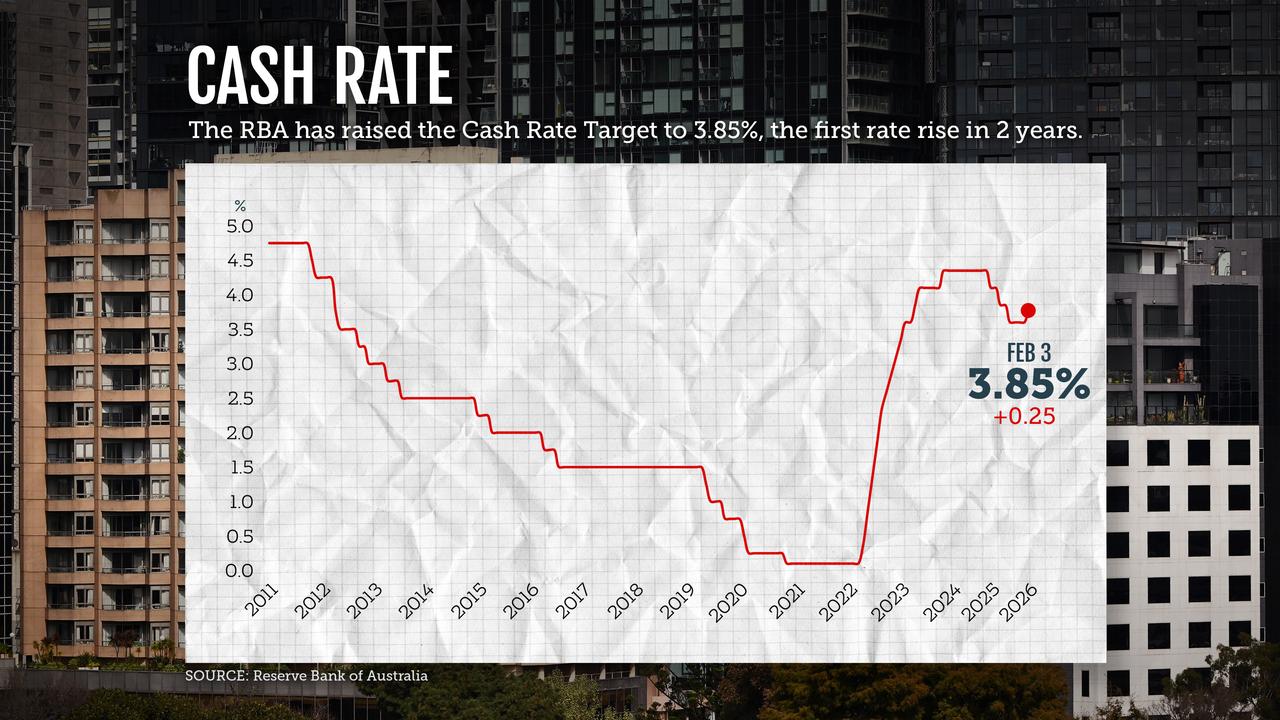
Australia’s central bank will hold a second meeting of its monetary policy board in mid-March, after raising the cash rate a quarter of a percentage point to 3.85 per cent in January.
It followed January’s data which showed inflation coming in hot, with the consumer price index at 3.8 per cent.
The Reserve Bank is widely tipped to raise rates again in 2026, with NAB economists forecasting the board to lift rates to 4.1 per cent in May, then keep them on hold until late 2027.
For rates to remain on hold for the rest of 2026, the bank says the data will need to change quickly with a “material downward revision to inflation forecasts”.
ANZ economists are also expecting a 0.25 percentage point rise in May.
The Reserve Bank’s target band for inflation is between two and three per cent, and relies on figures from the Australian Bureau of Statistics to monitor the situation.
It became the first major central bank to lift rates after previously cutting them following the inflation spike from the COVID-19 pandemic.
NAB head of Australian economics Gareth Spence said the bank was forecasting a rise in May would be the last for 2026.
“Household spending has really accelerated, disposable incomes have improved throughout last year and purchasing power picked up,” he said.
Mr Spence said while attention remained on government spending with the federal budget due to be handed down in May, all eyes should turn to the private sector.
The unemployment rate remained at a low 4.1 per cent, he noted.
Mr Spence said state government infrastructure pipelines were also levelling off as more projects neared completion.
Wall Street investors are meanwhile dealing with a handful of persistent concerns, particularly over financial and tech stocks.
The major US indexes have suffered their largest monthly percentage declines in a year and all three ended decisively lower on Friday.
The Dow Jones Industrial Average fell 521.28 points, or 1.05 per cent, to 48,977.92 while the S&P 500 lost 29.98 points, or 0.43 per cent, to 6,878.88.
The Nasdaq Composite leaked 210.17 points, or 0.92 per cent, to 22,668.21.

Australian share futures slipped back 20 points, or 0.21 per cent, to 13,722.
The S&P/ASX200 rose 23.3 points on Friday, up 0.25 per cent to 9,198.6, and up 3.7 per cent in February, as it notched its best close.
The broader All Ordinaries gained 26.9 points, or 0.29 per cent, to a record close of 9,435.6.

Australian Associated Press is the beating heart of Australian news. AAP is Australia’s only independent national newswire and has been delivering accurate, reliable and fast news content to the media industry, government and corporate sector for 85 years. We keep Australia informed.